Since the dawn of the automobile, humanity has been obsessed with speed. What began as a practical quest to replace horse-drawn carriages quickly evolved into an intense, high-stakes arms race among visionary engineers and elite automakers. Every era has had its mechanical benchmark, from the Jaguar XK120 crossing the 120 mph barrier in the 1940s to the legendary Bugatti Veyron shattering the mythological 250 mph ceiling in the mid-2000s.
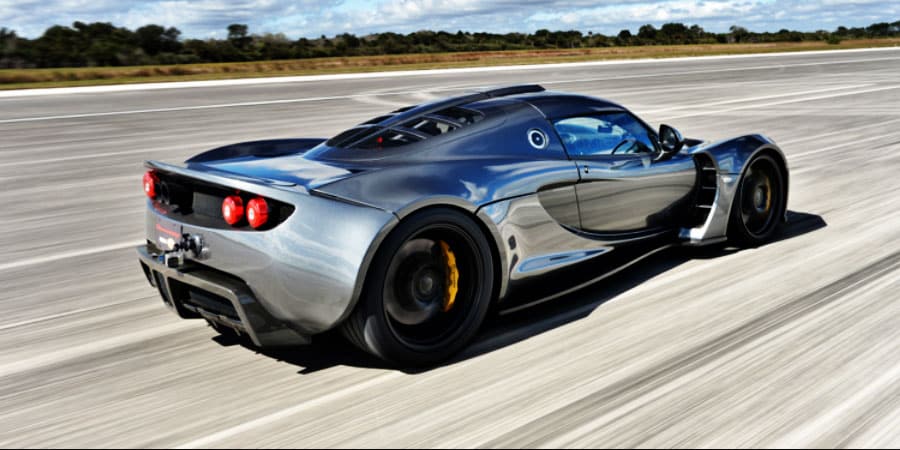
Today, the threshold of automotive performance has reached levels that once seemed restricted to sci-fi movies and aerospace engineering. The title of the world’s fastest production car is a moving target, continuously contested by internal combustion masterpieces and cutting-edge electric powerhouses. Looking at the peak of current performance, exploring the engineering required to sustain these speeds reveals a masterclass in physics, aerodynamics, and pure human ambition.
The Reigning Champion: Koenigsegg Jesko Absolut
When discussing the absolute pinnacle of street-legal velocity, the conversation invariably leads to Angelholm, Sweden. The Koenigsegg Jesko Absolut currently stands at the apex of automotive speed, built specifically to cross boundaries that no production car has ever touched.
Unlike its sibling, the Jesko Attack, which is built with a massive rear wing for track cornering downforce, the Absolut variant is a specialized straight-line missile. Powering this machine is a 5.0-litre twin-turbocharged V8 engine. When running on E85 biofuel, this mechanical marvel pumps out an astonishing 1,600 horsepower and 1,500 Nm of torque.
Every single element of the Jesko Absolut is optimized to reduce aerodynamic drag to a microscopic coefficient of just 0.278 Cd. This extreme streamlining gives the vehicle a theoretical, wind-tunnel-modeled top speed of 330 mph (531 km/h). Founder Christian von Koenigsegg has explicitly stated that the company will never attempt to build a faster street-legal car than the Absolut, cementing its place as the definitive endpoint of their speed legacy.
The Electric Disruptor: Yangwang U9 Xtreme
While internal combustion engines have spent a century refining their speed formulas, the landscape of velocity has been dramatically disrupted by the arrival of ultra-advanced electric vehicles. The most shocking entry in the modern speed war is China’s Yangwang U9 Xtreme.
Historically, electric vehicles were praised for their immediate off-the-line acceleration but struggled at high top speeds due to single-speed gearboxes and battery heat dissipation. The U9 Xtreme rewrote the rules by logging a verified production car top speed of 308 mph (496 km/h) during rigorous track testing.
Driven by a revolutionary quad-motor system pushing a combined 3,000 horsepower, and supported by an advanced 1,200-volt electrical architecture, this hyper-EV utilizes independent torque vectoring to manage power delivery safely at extreme speeds. The U9 Xtreme marks a monumental turning point, proving that the future of extreme velocity is no longer bound to fossil fuels.
Overcoming Physics: The Multi-Million Dollar Engineering Battles
Building a car that can comfortably travel at over 300 miles per hour requires far more than just dropping a massive engine into a lightweight chassis. At these extreme velocities, the laws of physics become increasingly hostile, turning the surrounding air into a substance that feels as thick as molasses.
Managing Aerodynamic Lift
The primary challenge of extreme speed is keeping the car firmly glued to the tarmac. If air slips underneath the vehicle incorrectly, the car can instantly transform into an airplane wing, lifting off the ground with catastrophic results. Engineers utilize active underbody aerodynamics, elongated carbon-fiber rear monocoques, and specialized venturi tunnels to create a vacuum effect that sucks the car down onto the road without creating excess drag.
The Tire Longevity Dilemma
The true limiting factor in the quest for 300+ mph is not engine power, but tire technology. At high speeds, the centrifugal force acting on a tire is immense, threatening to tear the rubber tread away from the steel belts. Companies like Michelin must design bespoke, aviation-grade rubber compounds reinforced with aramid fibers to withstand the heat and extreme rotational forces generated over sustained high-speed runs.
Conclusion
The pursuit of the world’s fastest car is a testament to what happens when human ingenuity refuses to accept limitations. Machines like the Koenigsegg Jesko Absolut and the Yangwang U9 Xtreme are far more than status symbols for billionaires; they are rolling laboratories. The aerodynamic breakthroughs, advanced thermal management systems, and high-strength composite materials developed to survive at 300 miles per hour eventually trickle down, influencing the efficiency and safety of everyday passenger vehicles. As the boundaries between internal combustion mastery and electric innovation continue to blur, the race for ultimate velocity remains one of the most thrilling spectacles in human engineering.